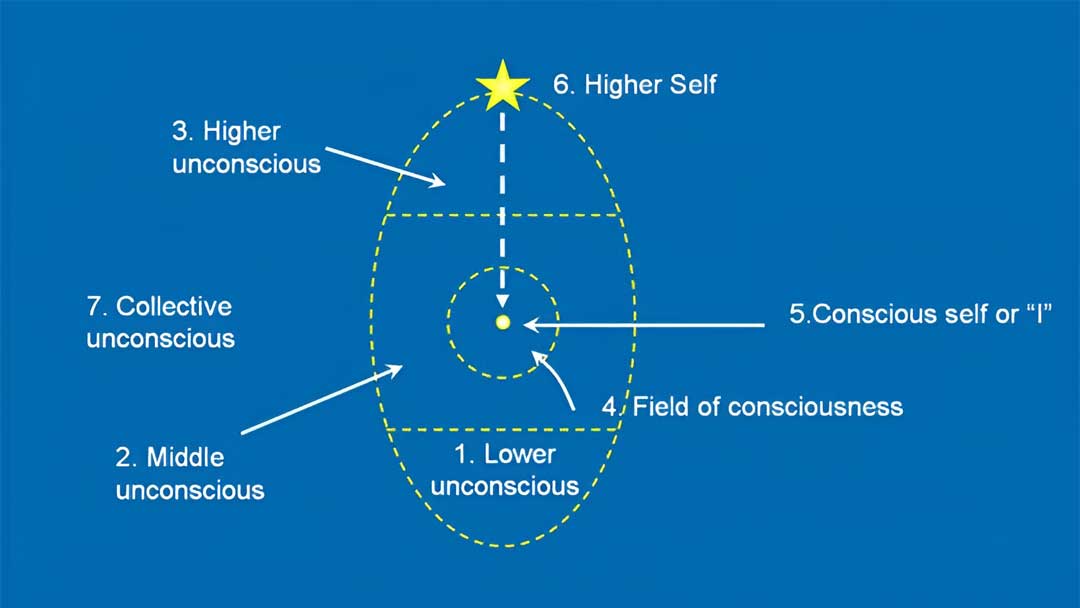
Before Enlightenment
Immediately prior to enlightenment, the Self is centred in the mind (the highest aspect of the personality triad – mind, heart and body). At the moment of enlightenment, the Self transcends the personality and centres itself in the soul. In transcending the personality our consciousness becomes more transpersonal (not limited to the personal). The Self must transcend the personality to complete the final stage of human evolution, namely, to dissolve the remaining ego structures and refine the personality. Just as we cannot demolish a building while we are still living in it, the last of our ego structures cannot be dissolved while our Self is centred in the personality. After enlightenment, the personality remains an important aspect of our being, but we are no longer identified with it. The mind, emotions and body are simply tools that we can utilise in our daily lives. Tools that we can continue to utilise for the development of our consciousness, but in a different way now.
After Enlightenment
Many of the things that I am about to describe are often experienced for short periods of time prior to enlightenment, as we are given glimpses of what lies ahead for us:
- Most people think that enlightenment will be something different and amazing (e.g. peace, bliss and unity), but we are already these things – they are our true nature. When we rediscover our true nature we realise that these qualities have been present all along, we just didn’t notice them. So yes, enlightenment is quite different in some respects, but it is also very normal and familiar.
- Our new sense of Self is far subtler than our old (false) sense of self, so much so that we may initially believe we have no self.
- We discover subtle new ways of being, knowing, loving and doing.
- Finding and realising our life’s purpose becomes less important as our concept of a personal self and ego-driven goals fade away.
- “I” becomes “I am” (presence), then eventually “I am everything”. But it also becomes “I am not” – initially as the absence of the ego-self, then later as the duality of being and non-being dissolves
- Without an ego-self to defend and bolster, we can relax into our being, which results in a relaxed confidence and a general sense that everything is ok.
- The entire personality relaxes under the direction of the true-Self. The need to plan our lives and control everything falls away, and without our old fear-based strategies we can relax and just allow life to unfold.
- A sense of direct knowing arises, which means we no longer need anyone else to validate our experiences, beliefs or sense of self.
- Our sense of Self is inherent – it is no longer derived from our thoughts, emotions or body, or feedback we receive from others.
- The mind becomes quieter and stiller. The constant labelling, narration and projection stop, and our personal story no longer seems so important.
- The emotions become purer, more authentic and less reactive. The heart opens up and personal, clingy love transforms into almost indiscriminate, unconditional love that is more intimate than anything we have ever felt before.
- The body relaxes and becomes more sensitive. Even the ordinary things in life take on a new depth and become extraordinary. It is like seeing the world through new eyes – everything seems so fresh, new, beautiful, exciting, curious and satisfying, and we sense the inherent “perfection” in all things.
- We realise that we are Life (Consciousness, God, Nature, Universe, Source, etc.) dressed up as a human being, and so is everyone and everything else. There is only one consciousness and Life is playing all the roles. But like a molecule of water in the ocean, each of us is a unique individual and a unified part of the whole.
Common Misconceptions After Enlightenment
Henry T Laurency wrote, in The Knowledge of Life Part 5, “The evolutionary way of man consists of a series of ‘awakenings’ and at these he is seized with the desire to throw ‘overboard’ all that he has acquired so far… This only shows how far he has still to go before he becomes one with all.” This section explains a couple of these common misconceptions:
- There is no individual Self: Some say that there is no individual Self and that there is only oneness. By definition there can be only one oneness (i.e. universal consciousness), so if an enlightened person was that oneness they would be the entire universe and would have detailed awareness of everything that is occurring within the entire universe. But they don’t; they only have detailed awareness of the part of the universe that is around them. So there is still an experiential centre of consciousness after enlightenment, but it is much subtler than the previous false sense of self was – hence the misunderstanding.
- (No individual Self means) we have no free will: Learning from our own decisions is an essential aspect of human development. It is true that ultimately everything is controlled by Life/Universe/God, but we are part of that universal consciousness. Gradually letting go of our individual will and becoming more aligned with universal will is an important aspect of our journey, but at no point do we have to completely give up our individual will. We remain an individual while our consciousness expands into the universal oneness.
Common Difficulties After Enlightenment
The significant shift in our identity that accompanies enlightenment can give rise to some difficulties:
- Integration Time: It is quite normal to be a little “spaced out” after completing any healing and reintegration work, as our psychological circuitry re-wires itself. After enlightenment, these changes may be more significant and have longer-lasting effects on our psychological state. So please don’t make any important decisions until everything has settled down.
- Lack of Motivation: After enlightenment, our ego’s false-will may no longer be accessible, so unless we have already activated our essential-will (an essential quality) we may be left with no will or motivation. Without anything to motivate us we will not want to do anything, which could cause our entire life to fall apart. It won’t matter to us, but it may affect those around us. It can take months or years to develop sufficient essential will to enable us to properly function in the world again.
- Remaining Ego-Structures: We can’t completely demolish our home (ego) while we are still living in it (prior to enlightenment). So after enlightenment, when our Self has moved out of the ego, we must finish “metabolising” any remaining ego structures to refine our personality and complete the final stage of development through the human kingdom. Until we do this, the remaining ego structures will still activate and adversely impact our life.
Generally, the more ego structures (false qualities) that remain at the time of enlightenment the more difficulties will be encountered. So it is advisable to do the inner work first and allow enlightenment to occur naturally, when we are truly ready.